
Pocahontas Projected Versus Actual Release
A projected release date is a sentence calculation at a point in time. WVDCR directives call the underlying figure the “minimum discharge/final release date.” It draws from the maximum term, court-awarded jail credit, eligible good time, and other authorized adjustments. The public OIS label may say “Projected Release Date.” Neither phrase proves that a person actually left the institution on that date.
An actual release is a completed movement. The strongest record states its date, time, method, and destination. A person may leave one site for another prison, a regional jail, federal custody, or ICE. That is a transfer, not community release. A person may also leave prison for parole or mandatory supervision while the sentence remains active.
A pretrial person at Tygart Valley Regional Jail and Correctional Facility usually has no prison-style date. Bond, dismissal, a plea, sentence, and other holds can change custody. Use the court order and WVDCR jail movement, not a sentence estimate based on the charge.
Lookup Pocahontas Projected Release Dates
The correct route depends on the custody system. For a state sentence at Denmar Correctional Center and Jail or another prison, begin at the official WVDCR search hub. For a local jail case, use the Jails search and the Pocahontas court. Federal and immigration systems require their own locators.
- Open the WVDCR Offender Search landing page rather than an old deep link.
- Choose Prisons for a state sentence or Jails for regional-jail custody. Search with the full name and OID when known.
- Open the matching record. Copy the exact date label, status, institution, OID, and access date.
- Obtain the signed sentencing and commitment orders through the West Virginia Court Record Access hub. Confirm terms, jail credit, and whether sentences are concurrent or consecutive.
- Ask WVDCR Records for the current and prior time sheets if the date changed or the public result is unclear.
- For a past event, request actual release date and time, method of discharge, destination, and terminal movement.
The official search hub is the supported entry point for its separate tools:
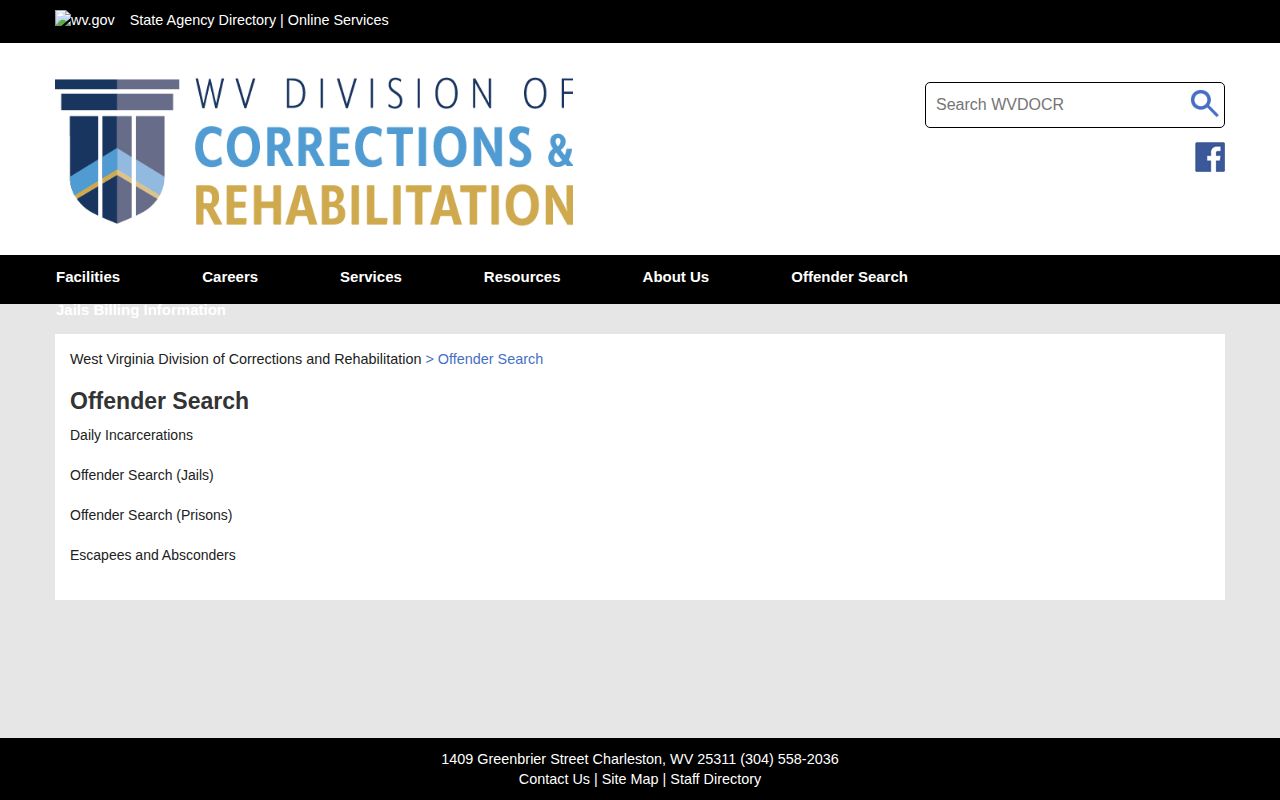
The hub separates daily incarcerations, jail search, prison search, and escapee or absconder information. Daily custody is not a release calendar.
Pocahontas Release Date Labels
Three dates answer different questions. Parole eligibility is when the Board may consider release. It creates no right to leave custody. A projected or minimum-discharge date is a calculation that may change. Actual release is the completed movement. Preserve each source label and never rewrite a future estimate as a past release.
| Date | Meaning | Best source |
|---|---|---|
| Parole eligibility date | First point at which parole consideration may be allowed | Sentence, statute, WVDCR and Board record |
| Projected release | Current estimated minimum discharge based on credited time | OIS and current WVDCR time sheet |
| Mandatory supervision start | Institutional exit into a required supervised phase | Time sheet, statute and WVDCR movement |
| Actual release | Completed exit from the named facility or system | Dated terminal movement |
| Final discharge | End of sentence or supervision | Discharge certificate or responsible authority |
A parole grant is also not an actual date. The West Virginia Parole Board may grant, deny, or “set up” a later hearing. Regional-jail grants usually require later DCR intake and release processing. Check Post-Release Supervision for the decision and supervision routes.
Pocahontas Good-Time Release Calculation
West Virginia does not use a general federal-style “serve 85 percent” rule. No blanket 85% formula appears in the controlling state good-time law or the current WVDCR directive. Offense-specific minimum terms, exclusions, and parole limits can still apply. The conviction statute and certified sentence control.
West Virginia Code §15A-4-17 generally deducts good time from the maximum term of an eligible indeterminate or determinate sentence. An eligible incarcerated person earns one day for each day physically incarcerated, including presentence jail days credited by the court under §61-11-24. Good time does not accrue while the person is on parole, bond, or another nonincarcerated status. Life sentences are ineligible. Consecutive maximum terms are aggregated.
The law permits forfeiture after disciplinary violations and restoration with commissioner approval. It also permits discretionary extra good time for qualifying emergency service and up to 90 days for an eligible approved academic or vocational program that was not required. These are documented credits, not amounts a reader should guess.
The WVDCR good-time directive describes the minimum discharge/final release calculation. The time-sheet directive requires revisions when lost, restored, or extra good time changes the result. That is why an older screenshot can disagree with a current date.
Compute Pocahontas Sentence Dates
WVDCR, not a public web calculator, performs the official calculation. The workflow shows which source facts must be present. It should be used to audit the record, not to announce a date from charge labels.
- Read the certified sentencing and commitment orders.
- Identify determinate or indeterminate terms and concurrent or consecutive structure.
- Confirm the effective sentence date and court-awarded presentence jail credit.
- Aggregate consecutive maximums where required.
- Apply only documented eligible good time, forfeitures, restorations, extra credit, street credit, and no-credit time.
- Account for mandatory-supervision conversion and any distinct supervised-release term.
- Keep the result labeled projected until an actual movement is recorded.
For an apparent error, compare the time sheet with the commitment order. A sentencing or commitment-order issue goes to the issuing court clerk and counsel. A calculation issue goes to WVDCR records staff. Ask for both current and prior time sheets plus the entries that caused each revision.
WVDCR Records
1409 Greenbrier Street
Charleston, WV 25311
Phone: 304-558-2036
Pocahontas Mandatory Supervision Dates
For certain violent-person felonies, firearm felonies, and felonies with a minor victim committed on or after July 1, 2013, state law converts one year of accumulated good time into one year of mandatory post-release supervision. Courts may order up to 180 days for other qualifying felonies. This feature can make institutional release earlier than final sentence discharge.
The distinction is central to a release date lookup. A person can be physically outside Denmar while still under mandatory conditions. The OIS movement may show exit from prison, the supervision record may show an active term, and the later discharge certificate may mark the sentence's end. Those records do not conflict. They describe different stages.
- Good time
- Eligible credit deducted from the maximum sentence under state law.
- Jail credit
- Time the sentencing court credits for qualifying presentence confinement.
- Dead time
- A documented period that does not count toward the sentence calculation.
- Mandatory supervision
- A required community phase that can begin before final discharge.
- Detainer
- A hold or notice from another authority that can affect the release destination.
Why Pocahontas Release Dates Change
A date moves only for a supported reason. WVDCR policy calls for revisions, and the court can correct or change the legal inputs. Keep old and new time sheets when the history matters.
| Change | Possible effect | Record to request |
|---|---|---|
| Corrected jail credit | Moves the computed date | Court order and revised time sheet |
| Good-time forfeiture or restoration | Moves the minimum date later or earlier | WVDCR calculation entry |
| Extra eligible credit | May advance the estimate | Approval and revised time sheet |
| New or corrected sentence | Changes terms or aggregation | Certified order |
| Escape or no-credit period | May delay the calculation | Movement and time-sheet entries |
| Detainer or transfer | Changes where the person goes | Terminal movement and receiving authority |
| Parole decision | May authorize a later supervised exit | Board decision and actual movement |
County-jail release on bond, dismissal, or a short court-fixed term does not necessarily use the prison projection. Use the signed court order, credited days, WVDCR jail movement, and any other hold. Never calculate from an accusation alone.
Confirm Pocahontas Actual Release Dates
For a future state-custody change, register through the VINE Inmate Check. VINE supplies timely notice but may lag and can report a transfer. For historical proof, request the release screen, chronological movement, actual date and time, method of discharge, destination, and any releasable certificate.
WVDCR's public interface warns that online data can change quickly and may not show true current location, release date, or status. Save the exact search result and timestamp. Then verify it with the facility or records office. A missing active result is only a lead, not proof of release.
If a court order and custody record appear to disagree, compare their roles. The order authorizes or changes custody. Institutional processing executes it. A signed Friday order can precede the actual exit, and another warrant or detainer can prevent community release. Ask the custodian what terminal movement was recorded.
Request Pocahontas Time-Sheet Records
A useful request identifies the person, OID, institution, and sentence period. Ask for the current and prior time sheets, the projected minimum discharge entries, and the reason and date for each revision. If the person has already left, also request the actual terminal movement, release method, destination, and any releasable discharge certificate. Electronic delivery can reduce reproduction cost.
WVDCR Policy 142.00 identifies many release-related fields that may be requested, including commitment and release dates and times, parole eligibility, full-term expiration, projected minimum discharge, good-time allowance, jail credit, no-credit time, institution, mandatory release, discharge method, OID, and destination. The broader offender file can remain controlled or redacted. A focused list gives the custodian a clearer record request.
Under West Virginia FOIA, the agency must act as soon as practicable and within five days excluding weekends and legal holidays by producing records, arranging inspection, or issuing a reasoned denial. Ask for segregable release facts if part of the record is withheld.